
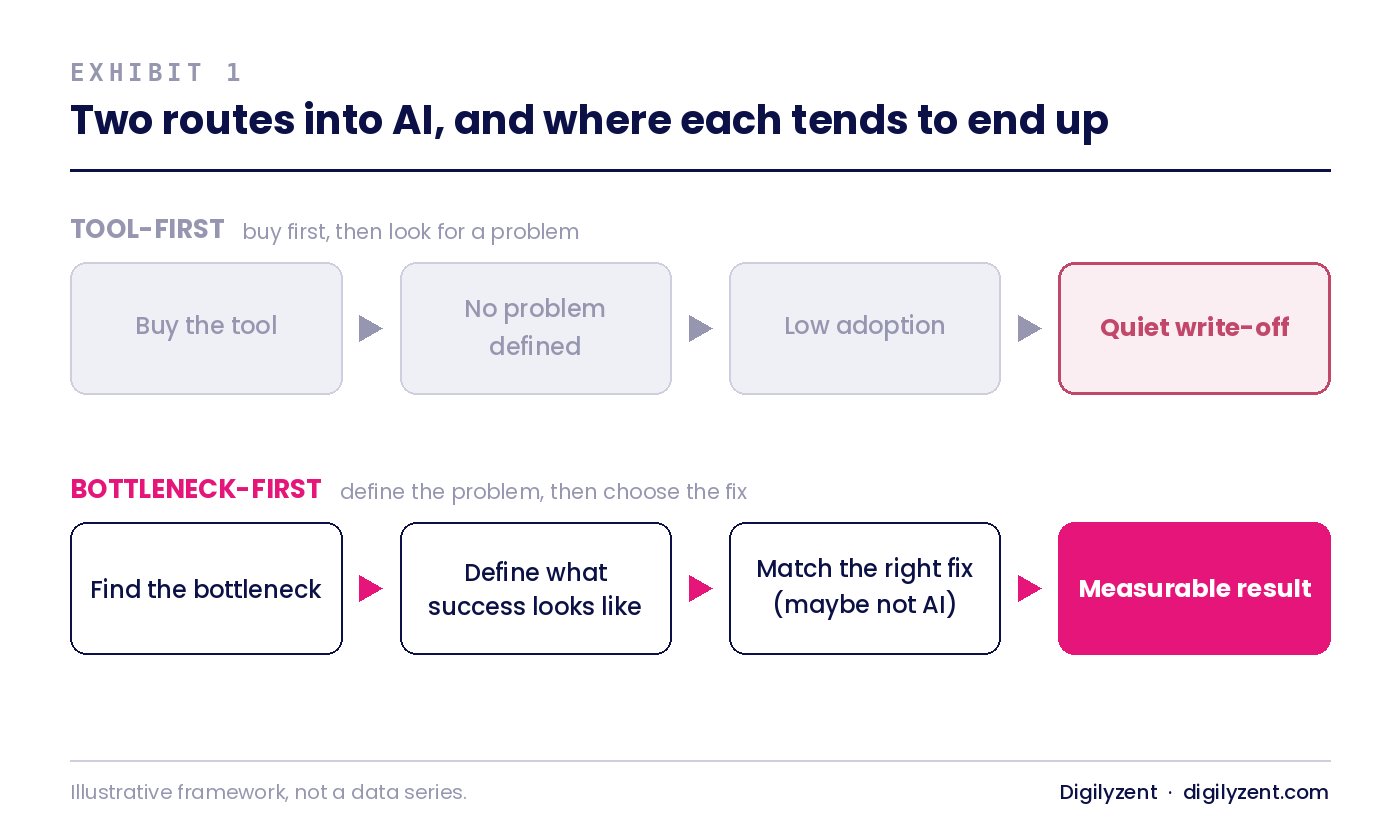
Here is a story we see often enough that it has become its own genre.
Someone in the business watches a demo. The demo is good. They always are. Twenty minutes of a clean interface turning a messy problem into a tidy chart, and by the end you can picture your own company running that smoothly. So they sign up. Five seats, maybe ten. There is a burst of enthusiasm in the first week, a few people poke at it, and then the calendar fills back up with real work. Three months later it is a line on the company card that nobody can quite account for, and an unspoken agreement never to bring it up.
The tool was not the problem. That is the part most people skip past. The problem was that it answered a question nobody had actually asked.
We think the whole tool-first habit is backwards, and we are happy to argue the point.
Buying something feels like progress
It is worth being honest about why this keeps happening, because the people it happens to are not careless. They are under pressure. Every newsletter, every competitor’s post, every conference keynote is telling them that AI is already remaking their industry and they are late. In that climate, buying a tool feels like doing something. It is visible. You can put it in a board update. You can say, truthfully, that the company has adopted AI.
But adopting a tool and solving a problem are not the same act, and the gap between them is where the money quietly goes. A tool is a means to an end. When you buy one without having settled what the end is, you are paying for capability and hoping a use for it turns up later. It rarely does.
Use cases do not emerge from software. They come from the work.
The bottleneck is hiding in plain sight
The good news is that the thing you should be fixing is almost never hidden. It is just so familiar that nobody thinks of it as a problem anymore. It is the bit everyone grumbles about and nobody has measured.
A few honest ways to find it:
- Follow the copy and paste. Anywhere a person is moving information from one screen into another by hand, every day, is a candidate. That is unpaid, error-prone work that a machine was built to do.
- Follow the phrase “let me just check with”. If the answer to a routine question lives in one person’s head, or can only be produced when that person stops what they are doing and goes digging, you have found a bottleneck wearing the disguise of a helpful colleague.
- Follow the late nights. The week or the weekend that disappears every month-end is not a fact of nature. It is usually a reporting process held together with manual steps that grew one patch at a time.
- Ask your team where the work feels stupid. They know. They have just stopped expecting anyone to do anything about it.
Three questions before anyone says the word “software”
Once you think you have found the snag, resist the urge to go shopping. Sit with it long enough to answer these first.
What exactly are we trying to change? Not “improve reporting.” Something you could put on a sticky note: cut the Monday sales report from a morning’s work down to a click. Specific enough that you would know the day it was true.
How will we know it worked? If you cannot describe success as a number, an hour saved, or a decision made on time that used to be made late, you are not ready to buy anything. You are still browsing.
What is it costing us right now? Count the hours, the mistakes, the deal that slipped because the figure was not ready when someone needed it. If the honest total is “not much,” that is not a failure to find a use for AI. That is a sign to leave this one alone and look elsewhere.
A small example
Picture a wholesaler with around forty staff. They come in convinced they want a chatbot, because a chatbot is what they have been reading about. Walk it back to the actual pain, though, and the chatbot has nothing to do with it. The real friction is that the sales team cannot get a straight answer to “what did this customer order last quarter” without waiting on someone in finance to pull it. The information exists. It is simply trapped in a system the people who need it cannot reach.
The fix here is not a chatbot. It is joining the order data into one place and giving the sales team a view they can check themselves. The clever AI component might be small, or there might be none at all. The relief is the same either way.
Had they bought the chatbot first, they would now own a chatbot sitting on top of data it still could not see, and the original problem would be exactly where they left it, only now with a subscription attached.
Sometimes the right answer is no AI
This is the part vendors will never tell you, so we will. The most valuable thing a proper diagnosis can deliver is the news that you do not need the thing you walked in asking for.
Quite often the cure is duller than AI and works better. A spreadsheet rebuilt properly. A process tightened so a step stops being necessary. A connection between two systems you already pay for, so the data stops being keyed in twice. None of that makes for an exciting case study. It is cheaper, it is quicker, and it tends to hold.
We would rather give a business that answer than sell it a project that photographs well and underdelivers in private.
The order that actually works
So before the demo, before the seats, before the kickoff call with the vendor: find the bottleneck. Name the task in a single sentence. Decide what success would look like. Only then is it worth asking whether AI is the right tool for the job, or whether something plainer will do it for a tenth of the cost.
That is the order we work in. The first conversation we have with any business is a diagnosis, not a pitch. A focused look at where the work genuinely snags, and an honest view on whether AI moves the needle for you or not. You do not need to have bought anything to start, and you will not be sold anything you do not need.